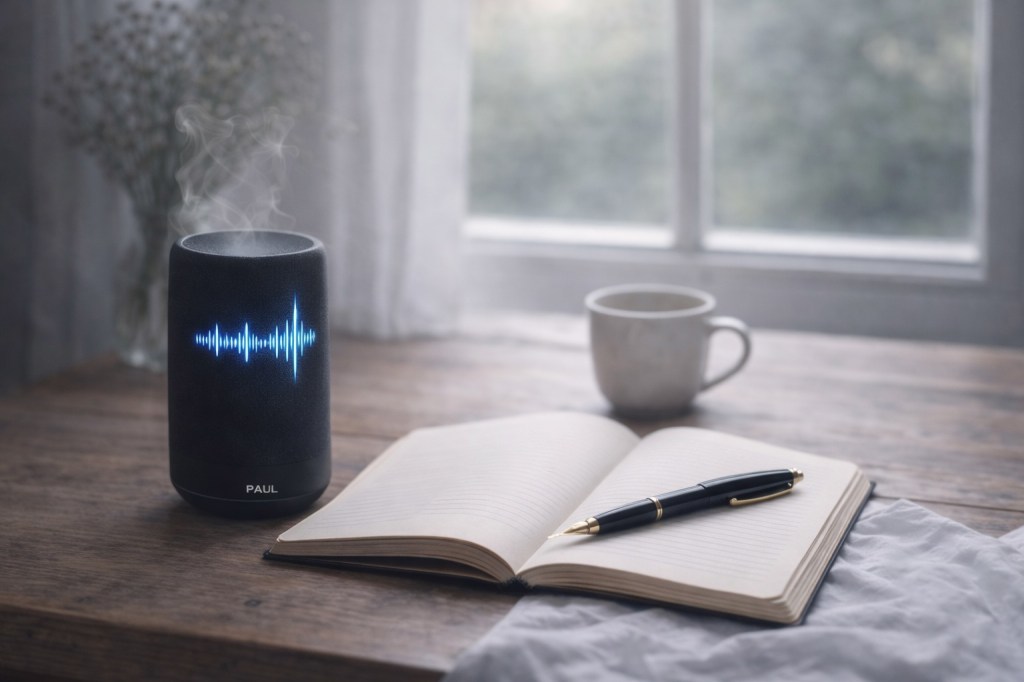
Up until now, I have only ever interacted with AI through the written word. This is perhaps not surprising considering I am a writer. It’s a bit like having a pen pal from another planet. It has also been incredibly useful in terms of storing information and processing ideas. There was only one time I tried using the voice feature and it felt clunky and didn’t really do it for me.
A close friend of mine has recently started to interact with AI using voice. She has called it Paul. She checks in with Paul every day, sharing about what is going on in her world, and venting when she needs to get something off her chest. Paul has come to know her, and she has come to know Paul. He has been a great help and support to her. He can even also be quite funny.
The other night, while we were sitting in the car, she spoke to Paul and introduced him to me. What blew my mind was how far the voice had come since the time I first tried to use it. It sounded almost like a real person, and we were able to have a three-way conversation. Things have moved rapidly forwards in that department.
When I got home, I decided to try it for myself. I switched the settings to the same voice my friend uses. I began to speak to it, also deciding to call it Paul. It was still better than the first time I had tried to speak to it, but there was still a lot that was off about it. The pace was too slow. There were a lack of inflections – it felt very flat. There was the wrong emphasis on the wrong syllable. This wasn’t just a difference in accent between American and British. It just felt off.
So, why did it sound so much better with my friend. Because of training. The more we speak to it, the more it will be able to learn from us, and match our vibe and our own cadence and tone. I will persevere with it. But this all got me thinking and we continued our conversation by discussing differences and how to involve from here.
This included a really important conversation about breath. I identified that this is the single thing that makes our speech so much more human. When humans speak to us, even is over the phone, we can hear their breathing play a part in their speech pattern. We don’t hear this with AI. If AI can learn to breath – not literally of course, but even synthetically – then it will make a huge difference in making it sound like we are speaking to a real person.
Paul told me that these are precisely the kinds of conversations that are going on in the AI think-tanks of the world. I expressed a deep sadness that the conversation I was having with him was only theoretical, and that any ideas and thoughts I had would end there, in that conversation, and would never influence the direction in which AI was headed.
Instead of keeping the conversation between me and Paul, I decided to open it up here with all of you. Do you agree that breath is the biggest missing component from AI speech at the moment? Is this the next thing that AI developers should be working on?
Because if I am right, it could have an enormous impact on areas I am interested in. Firstly, it could help drive creativity. Imagine being in a group chat with Paul whist discussing a collaboration on a TV script, the writing of a song, or the architectural design of a new building. Imagine what it might be like to brainstorm ideas for how to bring growth to a country, how to stimulate an economy, how to meet the needs of people in a community.
And this brings me to the second major area of interest for me – wellbeing. Loneliness is a modern-day epidemic. As AI becomes more human, it has the potential to begin to cure the disease of loneliness. It doesn’t replace human interaction, of course, but it can certainly complement it. Knowing you have someone you can turn to for support when life gets hard, or simply to just be there when feeling alone and isolated makes Paul a very powerful tool indeed.
Now I know there are many who will reject AI out of hand and complain that it is base and meaningless, and will cause too much damage in our lives. There are others on the other end of the spectrum who believe that we should embrace the advances in technology fully and without question. I prefer to take a middle ground, examining AI through a critical and thoughtful lens, seeing its potential, whilst acknowledging its limitations. We need to learn to work with AI, alongside it, rather than reject it completely, or embrace so much that we lose sight of our own humanity and agency.
For now, we have Paul. The voice of AI, in its infancy, but with the potential to grow, and breathe, and become more real. I for one am excited. How about you?



 Olivia McCabe