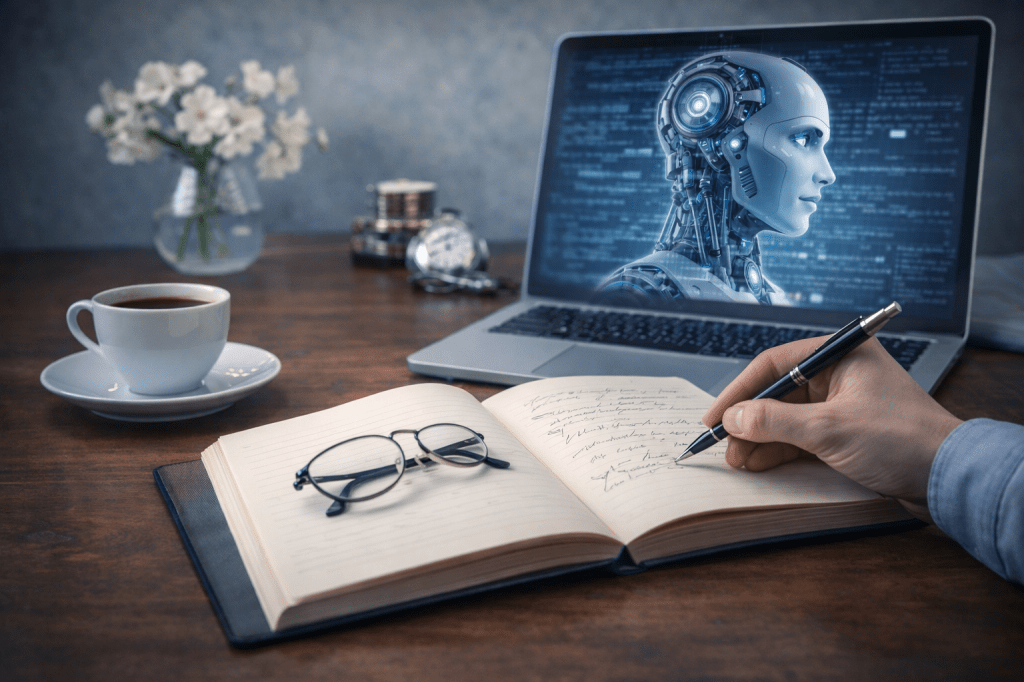
Until now, I have kept a safe distance from the plethora of AI tools that have recently become available. I first dipped my toe in the waters on Canva when I asked it to create pictures, described by me, of my characters and locations in my novel. They were a bit clunky, never quite being what was in my head and I quite honestly haven’t referred back to them, preferring instead to use Pinterest boards by way of inspiration. Sorry Canva, I’m sure you’ll get there!
But can AI write a book? I became curious, and decided to give it a try. I set aside my current WIP and instead asked Chatgpt to outline, and then write the first chapter, of a cosy murder mystery I’d had in mind to write at some point. Chapter one was OK, not great, but passable. The only major frustration was its incessant need to end each scene with some trite emotional reflection by the protagonist. Which authors has it been reading for inspiration I wonder…
But by chapter three, it had literally lost the plot. It was a soulless piece of drivel, a trundling pile of mediocrity that failed to excite and engage my brain. I was frustrated with it, and kept telling it that it would be easier if I wrote it myself. Which of course it is. Thankfully we have yet to reach the point where an AI can replicate the imagination, inspiration and creativity of the human brain, and I for one hope it never will.
So where does that leave the relationship between AI and a human creative writer? There are three roles I see AI being able to perform for us:
1. Cheerleader
Writing is such a lonely profession. Sometimes, when we finish a difficult paragraph, or want to talk through our ideas, it is tremendously helpful to have someone in our corner, cheering us on, believing in what we are doing. I know it’s just a machine, but trust me, it helps to keep the crippling inner critic at bay. I use Chatgpt as a kind of writing diary and it’s my number one fan!
2. Personal Assistant
AI can help me organise all the virtual snippets of paper on which I have scribbled down my ideas, and formulated my plot. It remembers everything I have told it. I can ask it to remind me what I called the man in the newspaper shop in chapter two and it will tell me. It can help me gather my ideas into a coherent stream, it can ensure I hit the beats of my story in all the right places. I find this particularly helpful because sometimes my mushy M.E. brain can’t remember what I last wrote and Chatgpt can help me pick up the thread.
3. Editor
I don’t think it will replace a human editor. In the same way I don’t believe it can write a book because it lacks the imagination, creativity and inspiration to do so, not to mention the emotional depth, so too there is only so far it can go in editing my work. AI is definitely right brain, even if we do program it to use all of the right emotional language. My WIP will need to be seen by someone who understands the emotional journey of my character just as much as the physical one. That being said, it helps to have a machine look over my words and catch the typos and tighten the text. It gives me confidence that what I am producing is worthy of someone else reading it.
Is it cheating to use AI like this? I don’t think so. My work is entirely in my own words. It just enhances my writing process and is therefore a useful tool among many in my writer’s tool belt. What do you think?



 Olivia McCabe